


Nobody Warned Me My Bright Kid Would Stop Asking Questions. Here's the One Thing That Got Him Curious Again

Results may vary from person to person
"Does he ever ask you why?"
My son's teacher asked me that at pickup one afternoon, kindly, while the rest of the kids filed past. She meant nothing by it. It still landed like a slap, because I had always thought of him as my curious one. His questions were the thing I hadn't noticed going quiet.
That night I actually watched him. Homework finished in silence, then straight to the tablet. I asked what he learned at school and got a shrug. The boy who used to take the remote apart just to see what was inside now answered everything in one word. The kind of quiet that makes you start worrying.
And it wasn't for lack of trying. We had the reading app, the math game, a subscription box of science kits, and a tutor on Thursdays. We used them all, in the right order, the way the parenting blogs swore we should.
And nothing changed.
He still reached for a screen the second he had a free minute. Still bored by anything that looked like learning. Still giving me one-word answers no matter how I asked. I'd never felt more helpless watching a kid check out of his own childhood.
Then a friend, not a teacher, not a parenting expert, just another mom whose son had gone through the exact same thing, told me something that changed how I saw all of it:
"It was never about finding a better app. We've quietly trained the questions out of them."
She explained that apps and worksheets only skim the surface. The curiosity I was missing starts deeper, in whether a kid actually wants to know something, and screens plus rote schoolwork slowly teach them to stop wondering. No app touches that.
"You've been feeding him answers," she said, "not giving him a reason to ask."
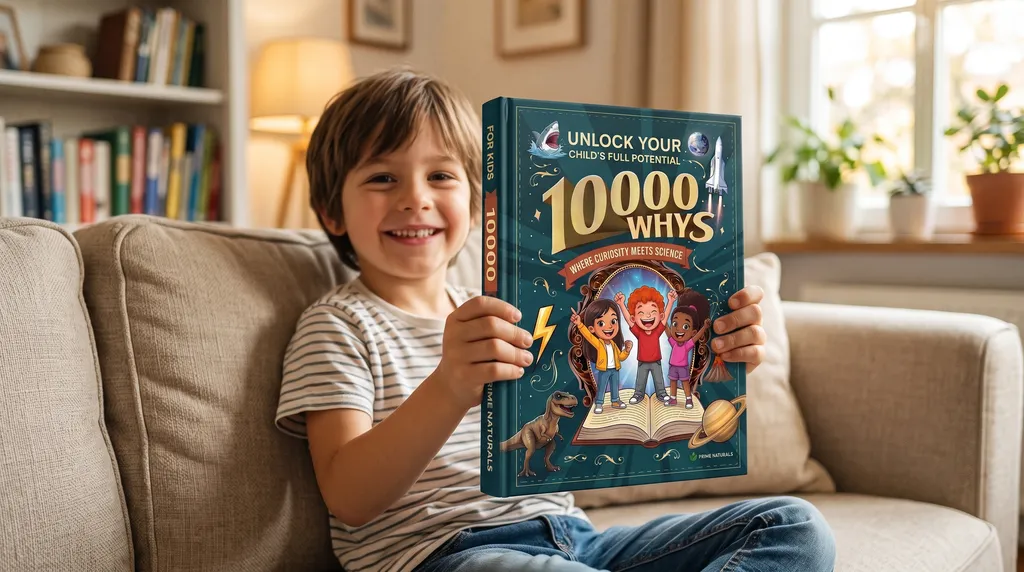
Then she reached into her bag and pulled out a thick hardcover book with a bright, busy cover. The Kid's Encyclopedia 10,000 Whys, she called it. Made to make kids want to ask again, not just hand them facts to memorize.
"This is what got my son reading on his own. It works because he actually wants to open it."
1. Nobody warns you: kids don't lose their curiosity by accident. Screens and rote schoolwork slowly train it out of them

The book was Kid's Encyclopedia 10,000 Whys. Here is what no teacher ever spelled out for me. Long days of screens, worksheets, and answers handed over on demand slowly wear down a kid's natural drive to ask questions, until the wondering just switches off. That is the real reason bright kids go flat, not laziness, and not some phase they will grow out of on their own.
Every copy is built around 174 real questions across 6 chapters, in a Complete Hardcover Edition made for kids ages 6-12, and it grows curiosity and thinking, memory and attention, and imagination and confidence.
The thing that stopped me was the reviews. 18,000+ families had already used it, and it held a 4.9 star rating across 2,847 reviews, with story after story of bored kids turning curious. I read a few of them twice. Every learning tool I had tried pushed facts at my son, and here was one built to make him want to ask in the first place.
Kid's Encyclopedia 10,000 Whys appealed to me because it wasn't another app or flashcard set. It works where curiosity actually starts, on the wanting-to-know side, sparking the questions my son had stopped asking instead of just cramming more facts into him.
The simplicity helped too. No screens to manage, no login, no worksheets to print. One book left out on the coffee table and that was it.
2. Week one: nothing changed, and nobody warns you about that part

Results may vary from child to child
Here's the part every glowing review skips: for the first week, nothing happens. The book arrived, I set it on the coffee table, said nothing, and waited.
Day one, he walked right past it. Day four, the same.
By day seven I was watching him from the kitchen every evening, hoping he'd pick it up, and finding the same kid reaching for the tablet. I texted my friend a draft complaint: "I don't think this one is landing with him."
I never sent it. Instead, I went back to what my friend had told me about why it works.
"It sounds silly saying it now," I admitted to her weeks later, "but that decision changed the whole thing."
What I realized is that the quiet first stretch is completely normal. Curiosity doesn't come back on command. A kid has to notice the book on his own terms, so the shift happens quietly long before you catch him actually opening it.
Most parents said the same thing happened around the end of the first week, not day one. The book sits there doing work you can't see, and most kids show no obvious interest yet.
Nobody tells you that part. If they did, I think fewer parents would give up at day ten the way I almost did.
So I left it there. I stopped hovering and waiting for him to notice, and told myself I'd give it a real month before deciding anything.
Turns out I didn't have to wait quite that long.
Somewhere in the first few weeks, something small shifted, and it caught me completely off guard.
3. One book on the table, and the first flicker of curiosity

Before I get to what changed, a word on how we used it, because I wasn't sure how to. There's no routine to enforce. You leave it where a kid will find it and let curiosity do the rest, over weeks, not one sitting.
The "no pressure" part matters, and it's the whole idea behind Prime Naturals 10,000 Whys.
Curiosity comes back the same way it faded, slowly, and pressure only pushes a kid further toward the screen. It's a bit like relighting a pilot light: you can't force the flame, you give it a spark it wants and let it catch. Leave the questions where a kid can find them and the wondering finally takes hold.
It's also why "wanting to" matters more than it sounds. A book a kid actually enjoys is one he'll still be reading in month three, and that self-chosen habit is exactly what curiosity needs. My biggest gripe with every learning app was the daily fight to make him use it. This one he reaches for himself.
In practice it took no effort at all. The book just lived on the coffee table. And then, near the end of week three, I caught the first real sign that something was happening.
It was a Thursday. I'd gotten used to the sight of him curled around the tablet the second dinner ended. That evening he was on the floor with the book open instead.
I want to be careful here, because I'd been let down by enough gadgets to distrust my own hope. Maybe he was just bored of the tablet. Maybe it was a fluke.
But it kept happening. The next few evenings, he drifted back to it, and stayed a little longer each time before anyone told him to.
Nothing dramatic. Nothing anyone else would notice. But enough to make me pause.
This lined up with what other parents described, the first small changes showing up in the first few weeks before the bigger shift later on. I was seeing the very front edge of it.
It was the first week in a long time I felt hopeful about my son instead of worried.
4. The morning everything started to shift
Results may vary from child to child
The shift didn't announce itself. Somewhere around week six, I came down to make coffee and stopped in the doorway, because he was already at the table, reading, before anyone had asked him to.
Then it kept happening. Mornings where he read a page before school. Questions at breakfast about things I couldn't answer. The closest I can get to describing it is that the kid I remembered was quietly coming back.
"Did you know this?" he asked me one morning, looking up from the book. "Iron rusts because of the water and the air. Both at once."
My husband noticed too. He asked what had gotten into him, which made me laugh, because he had no idea I'd put a book on the table at all.
Then came the moment that surprised me most. Around week seven, on a Saturday morning. He'd usually beg for screen time the second he woke up. Instead I found him on the couch with the book, asking if we could look up why the moon doesn't fall out of the sky.
He spent a whole Saturday morning reading and didn't ask for the tablet once.
"It's just one Saturday," I know. "But he hadn't picked reading over a screen in longer than I could remember. That morning he just did, without anyone pushing."
That same week, he asked two questions at dinner I genuinely couldn't answer, and he started bringing the book to the table. That alone felt like a real shift.
Because that is why so many parents quietly worry. Not grades. It's that sinking feeling when your kid is doing fine on paper but the spark you loved about him is fading out.
That was the first thing the Kid's Encyclopedia 10,000 Whys gave back to me, the sense that the curious kid I knew was still in there.
5. The moment others started noticing...

Through the second month, the change stopped being something only I could see. He was reading longer, asking sharper questions, explaining things back to us. People I hadn't told a thing started noticing.
Around week nine, we had dinner at my sister's place. She sees the kids all the time, so she is the last person on earth to hand out compliments.
"When did he get so curious? What are you doing with him?" she asked, after he explained why iron rusts to the whole table. Nobody had said anything like that about him in longer than I can remember.
And I hadn't prompted him at all that night. No "tell them what you read," no setup. He just did it on his own.
"That was when it stopped feeling like wishful thinking," is the honest way to put it. "It wasn't just me hoping anymore. Other people could see the change in him."
The comments kept coming after that. My mom said he seemed "switched on" again. And here's the part I never expected: his teacher called before I said a word, to tell me he'd become one of the most engaged kids in her class.
Those comments mattered because nobody knew about the book. They just saw a curious kid again, the way he used to be.
Which was exactly what I wanted.
That dinner is when I decided to write this. Nobody asked me to. I did it because I spent months afraid my bright kid was checking out for good, and I know how many parents are stuck in that same worry. If one book did what nothing else could, other parents deserve to hear about it.
"Getting him reading wasn't even the whole point," if I'm honest. "Watching him want to know things again was."
So if you're wondering why a stranger is telling you about a book, it's simple. The curious kid people keep mentioning is the reason I wrote this.
6. Why one book beat every app, tutor, and worksheet we'd tried

Here's what I finally figured out. Every app, worksheet, and reading game we had tried works from the outside. They push facts at a kid and reward him for finishing, and none of them touch the one thing that had actually gone quiet. My son's problem started on the inside, with a curiosity that had switched off, so nothing I made him do was ever going to fix it.
The 10,000 Whys book works from the other direction: it starts with wanting to know.
The book does two things at once, and that combination is why it worked when nothing else had. It answers the exact questions kids already wonder about, and it does it in a way that makes them want to ask the next one. Here is what convinced me, in plain terms.
Sparks the questions: Kids stop asking why when nothing around them invites the question. The book is built from 174 real questions kids actually ask, across 6 chapters, so instead of drilling facts it hands your child the exact wonderings that pull them in and keep them turning pages.
Feeds real curiosity: Apps hand kids an answer and move on, so the wondering never sticks. This book runs from why we have two eyes instead of one to why iron rusts to how black holes work, questions that reach from the deepest ocean to the edge of the universe, so there is always another one your child wants answered.
It actually gets read: This was my big hangup, because I'd bought plenty of "educational" things that gathered dust. It isn't a textbook or a reference tool. It's a hardcover kids pick up because they want to, written to be enjoyable enough that my son reaches for it on his own instead of a screen.
It builds over time: Most parents see their kids picking it up on their own within the first week or two, then asking deeper questions, then explaining things back. Unlike an app they drop the day the novelty wears off, this kind of curiosity keeps building the longer they stay with it.
Instead of stacking up more apps and subscriptions and hoping one sticks, you leave one book where your child can find it and let curiosity do the rest while you get on with your life. No logins, no schedule to enforce. That's it.
Real Kids, Real Curiosity.
Since I first shared what happened to my son and how the Kid's Encyclopedia 10,000 Whys turned it around, other parents have written to me with stories that sound a lot like mine. The tablet finally losing its grip. A kid asking questions at dinner again. Most of them said some version of "I assumed it was hype and now I'm annoyed it wasn't."
That is the kind of result I trust. Not a staged photo. Just those small moments when your kid picks the book over the tablet and starts asking why again.
Jennifer L.
✔ Verified Buyer"He's actually reading now!!! We've had this book 2 months and the difference is huge!!!!"
Margaret T.
✔ Verified Buyer"My daughter asks the best questions since we got this book. I love it!!"
David K.
✔ Verified Buyer"My son reaches for it over his tablet. So many new questions at dinner!"
Where to get the 10,000 Whys book (and what the current offer includes)

Results may vary from child to child
Here's the catch I promised. Most "educational" products only push facts at a kid or gamify a lesson, so they do nothing about the one thing that actually went quiet: the wanting to know. Others just dress up a workbook and call it fun. If you buy one of those and your kid never touches it, that isn't the idea of learning at home failing you. That's the wrong tool for the job.
What worked for us was the approach I keep describing: start with the questions a kid already wonders about, then answer them well enough that they want the next one. That's exactly what the Kid's Encyclopedia 10,000 Whys is built around, with 174 real questions across 6 chapters in one hardcover, for kids ages 6-12. Prime Naturals sells it through its official website, which lets them control quality on every print run and back each order with a 30-day money-back guarantee.
At the time of writing, first-time customers can claim:
- ✅ 1 Book for $39.90 (was $79.80), 50% off your first copy, perfect for one child
- ✅ Family bundles: 2 Books for $69.90 (extra 25% off), 3 Books for $79.90 (extra 40% off), up to 5 Books for $99.90 (extra 60% off)
- ✅ Free shipping and a 30-day money-back guarantee: if it doesn't do for your child what it did for mine, request a full refund. No questions asked.
Most parents see their kids picking the book up on their own within the first week or two, with deeper questions and steadier focus building from there. The 30-day guarantee matters because it means you get a full month to see the change before the window closes.
👉 GET THE BOOK »Why the 10,000 Whys book keeps selling out

Since word started spreading, the 10,000 Whys book has been getting a lot of attention from parents who are tired of screens and want something that makes their kids want to learn, not just another app. There's also a bottleneck the brand can't rush: each hardcover run is printed and quality-checked before it ships, which limits how fast Prime Naturals can restock when demand spikes.
If the promotion is still live when you click through, you may still be able to lock in 50% off your first book on the Kid's Encyclopedia 10,000 Whys before the current run sells out.
I don't usually end articles this way. But after watching my son fall back in love with learning, I'd feel wrong not mentioning that the current pricing won't last.
Click the button below to check availability and claim your discount on the Kid's Encyclopedia 10,000 Whys while the current promotion is still live.
Update: At the time this article was prepared, the Prime Naturals product page was still showing the promotional offer, low-stock messaging, and the 30-day money-back guarantee. There is no promise that the same discount, bundle availability, or shipping offer will still be there tomorrow. If you've been considering the Kid's Encyclopedia 10,000 Whys, it makes sense to check availability now rather than wait and risk missing the current promotion.