


For years my Christmas presents were forgotten by New Year's. Then my 9-year-old grandson started calling me every Sunday at five.
I'm 68, I have three grandkids, and I'd about given up on finding a present that lasted longer than the wrapping paper. My friend Bev's grandson calls her every Sunday with a question he's sure she can't answer, and every one of them comes out of the same book. That's why I'm buying it again this Christmas, and why I'd tell any grandparent to order it early.

I'm sixty-eight, and for years Christmas at our house ended the same way. By three in the afternoon the wrapping paper was in garbage bags, the new toys were spread across the rug, and all three grandkids were on the couch with a screen in front of their faces.
Two Christmases ago I counted. Twenty-three presents between the three of them, most of them from Ray and me. A remote-control truck. A slime kit. A robot you build yourself. By New Year's the truck's battery was dead and the robot was still in its box, and Caleb, who was ten then, had spent most of Christmas Day watching a video of other kids opening their presents.
I didn't say anything that day. You don't, at Christmas. But I stood at the sink scrubbing the roasting pan and wondered what all that money had taught them, apart from how good it feels to rip paper.
My daughter Lauren said it to me plainly in January. 'Mom, please. No more stuff next year. They have plenty, and they don't remember half of what they got.' She wasn't being unkind. She was right, and that was the part that stung.
The hard part was knowing what to buy. Gift cards feel like you gave up. Clothes are outgrown by spring. Every so-called educational toy I'd ever bought ended up in a closet once the newness wore off. I'd stopped asking what they wanted and started asking what would last, and I had no answer.
Then last November, Bev answered a question in our walking group's chat. About a dozen of us walk the river path on Tuesday and Thursday mornings, mostly retired, nearly all of us grandparents. Someone asked what everybody was getting the grandkids this year, and whether anyone had found a present the kids still used after the holidays.
'I got all five of mine the same book last Christmas, and they still call me about it every Sunday,' she wrote. 'Come for coffee and you'll see what I mean.'
I messaged her privately, a little skeptical, and it came out sharper than I meant it to.
'A book? Bev, I've bought them books. They thank me nicely and the books go on a shelf. Caleb's eleven now and he won't read anything that doesn't light up. What makes this one different?'
She didn't argue. She just told me to come over on Sunday, a little before five.
'That's when Wyatt calls,' she said. 'He's nine. Every week he picks a question out of that book he's sure I can't answer, and he phones to stump me. I lose on purpose about half the time. Come and listen, and then tell me it's just a book.'
The Sunday phone call at Bev's kitchen table

Bev's kitchen smelled like coffee and the chili she had going for supper. At five o'clock on the dot her phone lit up on the table, and she put it on speaker. 'Grandma,' said a small, very serious voice. 'Why is the ocean salty?'
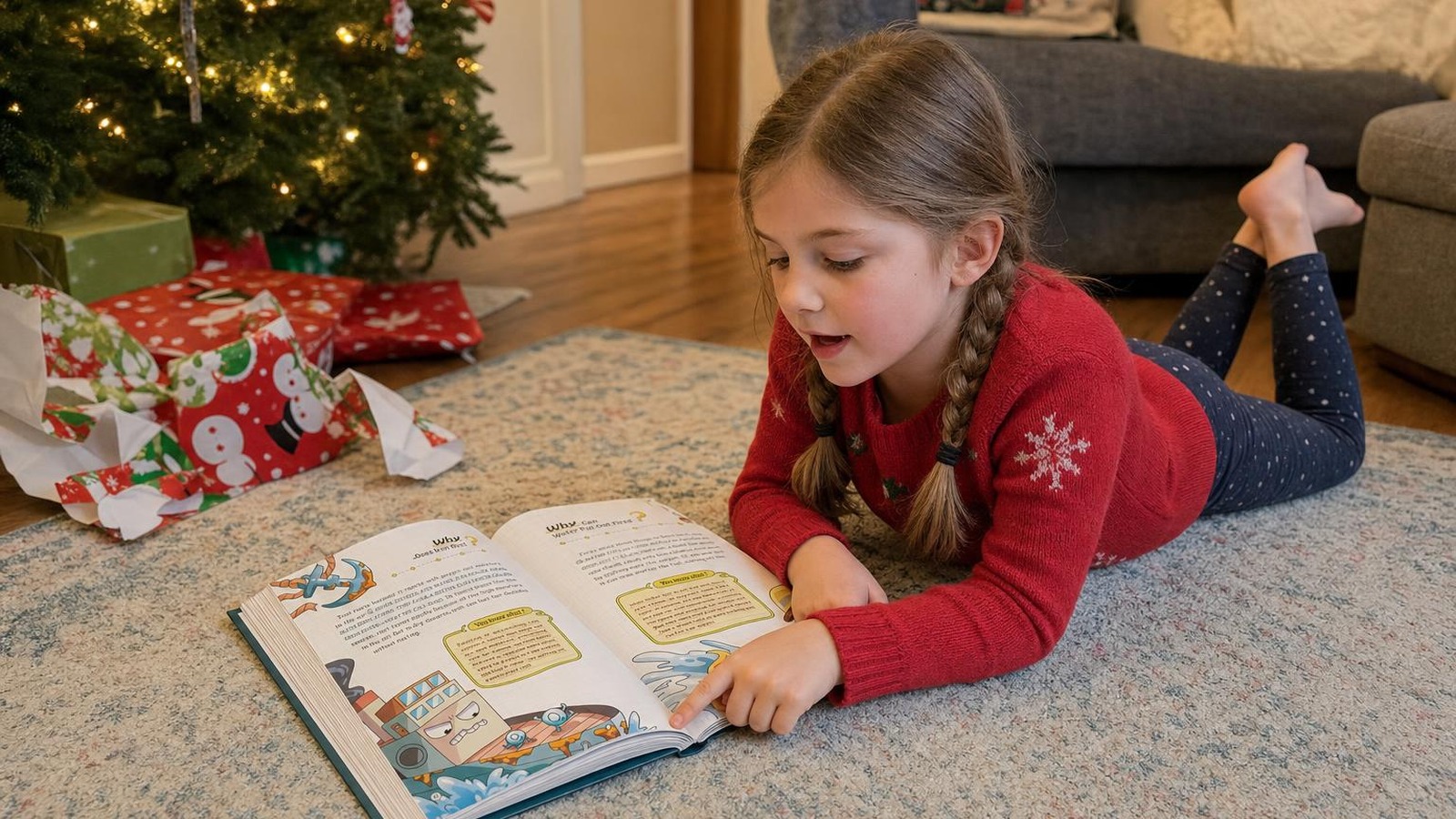
She guessed wrong on purpose, and Wyatt spent the next ten minutes explaining rivers and rocks and salt to her, with sound effects. When they hung up she slid the book across the table to me. A thick hardcover, dark teal with gold lettering, the kind of cover that already looks like a present. Every page takes one question a kid would really ask and answers it in short, plain bits, with big funny pictures. Space, dinosaurs, the human body, oceans, weather, volcanoes, how airplanes stay up.
'This is why I bought five,' she said. 'Every page is a question, and every question is something to tell somebody. My grandkids don't read it to learn. They read it to win.' 'It's written for ages six to twelve, so it fits all of mine. My youngest is six and reads it with her mom. My oldest is twelve and acts too cool for it, and he still calls to check his answers.'
I laughed. 'Bev, it's an encyclopedia. When did a kid last fight over an encyclopedia?'
'Watch what happens after Christmas Day,' she said. 'That's the part I care about. Anybody can open a present. I want to know what they're doing with it in February.' 'Your phone will ring before New Year's.'
I stayed doubtful. I'd bought plenty of things with the word educational on the box, and the only thing I'd ever seen them teach was how to stack neatly in a closet.
But I drove home thinking about a nine-year-old explaining the ocean to his grandmother over a speakerphone, and that night I ordered the three-book set. Ray didn't say a word.
Christmas week, and the phone call I didn't see coming

The box came in the second week of December. I opened it at the dining table while Ray was out, half expecting something thin that looked better in the photos than in your hands. It wasn't. Three proper hardcovers, heavy, each one in gift-ready packaging.
I wrapped them that afternoon, one for Caleb, who's eleven, one for Theo, who's nine, and one for Ruby, who's seven. Inside each cover I tucked a note: 'Call me when you find one I can't answer.'
Ray asked whether I'd bought them a real present to go with it. I hadn't. That was the whole experiment. For once I'd spent less, and I was nervous about it.
Christmas morning at Lauren's, the books came out of the paper and I watched their faces. Polite. A little puzzled. Theo said 'thanks, Grandma' the way you thank somebody for socks. Then the tablets came out like every other year, and I told myself I'd tried.
By early afternoon, Ruby had hers open on the floor by the tree.
By dinner, Theo had found the page about why we need sleep and was reading it out to anyone who'd stand still, which, if you knew Theo, you'd understand is its own small Christmas miracle.
Nobody had to charge it or argue over whose turn it was. There was a question, a page, and a kid who wanted to tell somebody the answer.
I texted Bev that night: 'Well. Ruby read hers before the pie. Is it always like this?'
She wrote back: 'Give it a week, that's the whole point. Kids keep going back to anything that hands them a little news to share, and they'll do it with a book they picked up on their own. Wait for Sunday.'
I caught myself smiling on the drive home. Christmas excitement, probably.
I'd half expected the books to end up next to the socks.
Ruby reading before the pie was enough for one day.
It was only Christmas Day, and nothing had been proved yet. Then on the Sunday after, at five past five, my phone rang. It was Theo, on his dad's phone, and nobody had told him to call. And the worry I'd been carrying about showing up with just a book suddenly felt a lot lighter.
I felt like a grandmother who'd given something that mattered.
And that was THE FIRST SUNDAY.
Why it worked when a closet full of toys never had
By the end of January I'd had a call from at least one grandkid every single Sunday. One week all three of them, fighting over the phone. I wanted to know why a book was doing what years of toys never had, so I called Bev and asked her.
What she told me made me wince a little, mostly when I thought about all the Christmases I'd judged a present by the size of its box.
Why the big presents are forgotten by New Year's
The usual Christmas advice for grandparents is to buy whatever's on the list. You get the toy the ads sold them in November, an hour of excitement, then a dead battery and a spot in the closet.
The other route is the educational present. Workbooks, flash cards, a science kit with forty steps. They nod, they say thank you, and by February most of it is still in the plastic. Kids know when a present is homework in disguise.
Kids learn the things they're already curious about, and they come with plenty of questions of their own. Why is the sky blue? Where did the dinosaurs go? Why do we dream? Answer those, and they come back on their own.
Why the 10,000 Whys does what a gadget can't
Bev put it to me like this:
'Wyatt has read that thing cover to cover twice, and he still finds a page to call me about. Every page they read is something new to tell you.'
The 10,000 Whys is built around the questions kids really ask, the ones they wonder about every day, so they're reading about things they already care about. Each answer is short and simple, with a big picture beside it, so Ruby at seven reads most of it herself and Caleb at eleven doesn't feel talked down to.
And it covers a lot of ground. Space, dinosaurs, the human body, oceans, weather, history, animals, science, plants, the brain, inventions and how the Earth was made, all in one book. Caleb lives in the space pages. Ruby loves the animals. Theo reads whatever will gross out his sister.
The fun and the learning come in the same package, so it happens without anybody pushing. You're giving them a reason to wonder about things, and a reason to call you.
Open it, find a question, read the answer, call Grandma. That's the whole routine, and Theo hasn't missed a Sunday since Christmas.
It turns curiosity into something they practice a little every week, because they want to.
It's the one present I've given that gets more use in February than it got on Christmas Day.
What Bev showed me inside the book
Bev walked me through hers page by page, so here's what you get with the 10,000 Whys:
The questions kids really ask: the everyday things children wonder about, like why the ocean is salty or why we dream, each answered in plain words with big, bright illustrations. It's written to be read for fun, so kids pick it up on their own
Twelve subjects in one book: space and the universe, dinosaurs, the human body, oceans and sea life, weather and nature, history, animals, science and physics, plants, the brain, technology and inventions, and the Earth itself. Whatever rabbit hole a kid falls into, it's probably in there
Ages 6-12 · Hardcover · Gift-ready · Nothing to charge. It's a sturdy hardcover that comes in gift-ready packaging, written for ages six to twelve, so the youngest and the oldest grandkids can share it. There's nothing to plug in or download, and Prime Naturals gives you 30 days to send it back for your money
The 10,000 Whys is $39.90 right now, down from $79.80. There's also a set of three for $79.90, which works out to one free, and a set of five for $99.90 with two free, and both sets ship free. The sets are worth a look if you've got more than one grandchild.
The Sunday dinner when Ray's brother asked, 'Where's he getting all this?'

We were about six weeks past Christmas, at a completely ordinary Sunday dinner at our house: Lauren and her family, Danny and Theo, and Ray's brother Gene, who comes most weeks for the pot roast.
I hadn't planned anything special. Ray was carving. The kids were supposed to be setting the table. Instead Theo had his book open on the sideboard and was quizzing his cousins, and nobody had told him to.
I didn't have to prompt anybody all evening.
Halfway through dinner, Caleb explained why volcanoes erupt using his mashed potatoes. Ruby told the whole table that an octopus has three hearts. That was the whole of it. Nobody was on a phone at the table, and nobody asked to be excused early.
That's when Gene put his fork down and watched Caleb finish his volcano. Gene spent forty years as an engineer, and he doesn't impress easily.
He'd known Caleb all his life as the quiet one with a tablet in his lap.
'Where's he getting all this?' Gene said, nodding at the kids. 'Every one of them has a fact for me. A year ago I couldn't get two words out of that boy.'
I laughed, and it caught in my throat for a second.
That was the moment it landed.
The whole dinner had gone by with the kids talking to us, and I hadn't noticed that the tablets were still in the car. Nobody coaxed them or told them to put anything away. I'd been so set on finding the right toy that I'd nearly missed what they wanted all along, which was something to tell us.
Then came the question I keep coming back to.
'Okay, what's the book? I've got two grandkids in Denver and I never know what to send them.'
'It's the 10,000 Whys. It's a hardcover full of the questions kids ask, with the answers and big pictures. A friend from my walking group gave it to all five of her grandkids the Christmas before last.'
'Write that down for me,' he said, already patting his shirt pocket for his reading glasses. One question at dinner turned into ten minutes of the kids showing Gene their favorite pages.
'That boy explained it better than half the engineers I worked with.'
'Hang on, I'll text you the link.'
When everyone headed home, Theo tucked his book under his arm to take back to his dad's, and Ruby asked if she could call me next Sunday to stump me about sharks.
Ray and I did the dishes without saying much. We didn't need to.
The month I watched it turn into a habit

The kids kept going back to the book, and the change came week by week, quietly, until I couldn't picture the holidays any other way.
Christmas Day: Polite thank-yous. Then Ruby on the floor by the tree with her copy open, and Theo reading the page about sleep out loud at dinner. Nothing dramatic, and I didn't expect it to be.
Week 1: The first Sunday call. Theo, at five past five, asking me why we dream. I guessed wrong. He was delighted, and he made me promise to be home the next Sunday too.
Weeks 2-3: The first real change. Caleb, who'd acted too old for it on Christmas morning, called on his own to ask whether I knew how airplanes stay in the air. He'd read the whole section first so he could correct me.
Week 4 on: This is when it stuck. Lauren texted me a photo of Ruby asleep with the book open on her chest, and Caleb and Ruby had started quizzing each other in the car. When Caleb called that Sunday, he sounded older, and proud of what he knew.
The best part was the small things adding up. A phone call here, a fact at dinner there. By February the books had dog-eared corners and a sticky note on every other page.
The strange part was how little I had to do. Book under the tree, phone on Sundays, done.
We still do the same tree and the same ham. Now my phone rings every Sunday at five.
Why almost nobody tells grandparents this

And now the part that still bugs me:
Nobody profits from telling grandparents to buy less. The list hands the choice to whatever was on TV in November, and the ads hand it to whoever had the biggest budget.
If a present kept a grandchild calling you every week, most grandparents I know would at least take a look. And almost nobody shows you one.
When did anyone last suggest a present that keeps the grandkids talking to you long after the tree comes down?
The big toy companies sell what sells. The boxes get bigger and the toys get louder, there's a new must-have every December, and most of them are in a closet by spring.
Ray's sister has a whole hall closet of them. Remote-control cars, robot kits, a drone that flew twice. Eight grandkids and ten Christmases' worth, half of it still in the boxes.
Then there's the 10,000 Whys.
It's one hardcover full of the questions kids really ask, about black holes, volcanoes and why leaves change color, answered simply and illustrated so they want to turn the page.
That's why the grandparents I know who've given it are still hearing about it months later. Ours are still on three nightstands, ten months after Christmas.
That's also why most grandparents haven't heard of it yet. And yet more than 18,000 families have one, and I'd never have heard of it if Bev hadn't answered that group chat.
Bev summed it up on the phone: 'Nobody gets rich telling grandparents to buy one book and wait by the phone.'
Why this Christmas, while they're six to twelve

This was the line from Bev that stuck with me:
'Between six and twelve they still want to tell you everything they know. Give them something worth telling while they do, and those Sunday calls will outlast any toy.'
Bev wasn't selling me anything.
All it takes is one book and one phone call a week. For us that's a question on Sunday at five, and five minutes of me being wrong on purpose.
And then the point that really hit me: their habits are forming right now, whether or not anyone hands them a book.
Every Christmas you wait brings them a year closer to the age when calling Grandma is the last thing on their mind.
And you don't wait long to see the first of it. At our house the first call came the Sunday after Christmas.
For a habit that sticks you want a couple of months of the same routine, and it keeps building from there. By Easter, Ruby had read hers cover to cover twice.
Believe me, I wish I'd done this years ago, when Caleb was six. I spent years buying bigger boxes and hoping one would stick. For the thing I really wanted, which was hearing from them, I'd been buying the wrong kind of present.
I don't get those Christmases back. But last year, three hardcovers went under the tree.
And honestly: your grandkids could be calling you with their first question the Sunday after Christmas.
Here's what happens if you keep putting it off:
This Christmas:
You ask the parents for a list and end up with the same toys the ads picked
The new gadgets get an hour of attention before the tablets come back out
You miss the first weeks of calls the other grandparents are already getting
The present that could already be wrapped is still sitting in your cart
This time next year:
They're a year older and a little harder to reach
Every holiday is another guess at what they'll use, if anything
The grandparents who ordered this Christmas are getting Sunday calls, and you still mean to order
You buy another pile of toys, and another Christmas goes by exactly like the last one
Bev was blunt with me about this:
Each year you put it off is another year of presents headed for the closet, and another year of grandkids who'd love something to tell you. One good book, one phone number, and let their curiosity do the work.
The good news is you can order yours and have it wrapped this week.
Here's what comes with the 10,000 Whys. A thick hardcover in gift-ready packaging, full of the questions kids really ask, twelve subjects including space and the human body, and big illustrations on every page, all written for ages six to twelve. For us it turned a pile of forgotten toys into a phone that rings every Sunday.
Each question they find is one more reason to pick up the phone, and every call makes the next one a little more likely.
Gene asked me what to send his grandkids in Denver.
I asked him this: Do you want your grandkids calling you with questions this winter? Or another box in the closet by spring?
And right now it's $39.90, down from $79.80, with a 30-day money-back guarantee if it turns out to be wrong for your family.
I'm writing this for every grandparent who's where I was two Christmases ago. It would have saved Ray and me a closet full of toys, and given me a few more years of Sunday calls.
The catch: you order it from the Prime Naturals website
That's where the $39.90 price, the free shipping on the sets and the 30-day money-back guarantee all apply, so it's the one place I'd buy it.
The upside is that it's simple: Free shipping on the sets, and 30 days to send the book back for your money.
Bev told me to order early so the books arrive well before Christmas, and to keep it simple. One book per grandchild, with a note inside the cover.
One of the women in our walking group told me her granddaughter called to stump her from the back seat of the car.
If you've got two or more grandkids, the sets are the better deal. The three-book set is the one I bought, one for every grandchild, and the five-book set covers a bigger family.
Here's the quick math. One book is $39.90 right now, down from $79.80. Three at that price would be $119.70, and the set is $79.90, so one is free. Five would be $199.50, and the set is $99.90, so two are free, and both sets ship free. The 30-day money-back guarantee covers every one of them.

A gift-ready hardcover for ages 6-12
The 10,000 Whys answers the questions kids really ask, across twelve subjects including space, dinosaurs and the human body, with big illustrations on every page: $39.90, down from $79.80.
What families are saying
Real reviews from 10,000 Whys buyers
Bought this for my grandson's birthday not knowing what to expect. He opened it, looked at the cover for about thirty seconds, and said 'is this actually mine?' He read it at his own party. His mum called me two months later to say he'd read it three times and was asking if there was a second one. Best gift I've given in years.
My daughter has never once picked up a book without being forced. I left this on the coffee table on a Friday. By Sunday she had read half of it and was explaining to her grandfather why the moon doesn't fall out of the sky.
I was skeptical. My son doesn't read. He's a screen kid. I put this on the coffee table and didn't say a word. Day 3, I found him on the floor reading about black holes at 9pm when I thought he was asleep.
If you've read this far, put one under the tree and wait for Sunday
For years I bought the biggest box I could find and hoped this would be the one.
The lists I followed. The 'Mom, please, no more stuff' from Lauren. The Christmas afternoons when I watched three kids on three screens and wondered what I'd really given them.
And then that Sunday dinner. 'Where's he getting all this?' Caleb at the table with a volcano made of mashed potatoes, and Gene reaching for his reading glasses. It took about four Sundays.
The same thick book kept working on their curiosity, one question at a time, and it kept my phone ringing every Sunday at five.
For a while I'd quietly decided that grandparents just didn't get to give the presents that matter anymore. I'd stopped expecting anything I wrapped to last past New Year's.
Last Christmas I gave three books. This year Lauren asked me to order two more for her best friend's kids, and my phone still rings every Sunday at five. I only wish I'd asked Bev about that book sooner.
- Choosing a selection results in a full page refresh.
- Opens in a new window.
- Choosing a selection results in a full page refresh.
- Opens in a new window.
